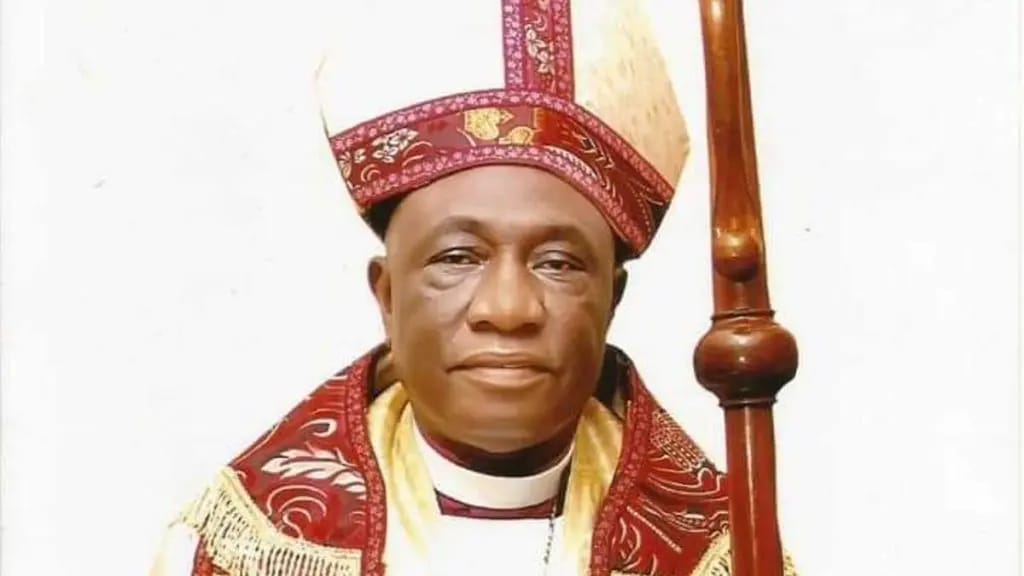
.Calls for Wealth Creation, Good Governance
The Archbishop of the Ecclesiastical Province of Kwara and Bishop of the Diocese of New Bussa, Israel Afolabi Amoo, has raised alarm over worsening insecurity, economic hardship, and governance challenges in Nigeria, warning that the country is drifting into a dangerous state if urgent reforms are not undertaken.
Delivering his Bishop’s Charge at the Second Session of the Sixth Synod held at St John Church, New Bussa, the cleric said insecurity has reached “an alarming frightening proportion” affecting all categories of Nigerians without distinction.
According to him, “the target group has cut across the rich, the poor, the unemployed, the employed, institutions, schools and places of worship,” adding that fear now dominates daily life across the country.
The Cleric lamented that Nigerians now face multiple threats ranging from armed robbery, terrorism, bad roads, flooding, fake drugs, and hunger, stressing that “there is no safety anywhere” and that every citizen “has a story to tell.”
The Archbishop warned that the rising wave of violence and lawlessness was discouraging investment and undermining national development. He noted that “a safe environment is a prerequisite for growth and development,” urging government to urgently strengthen the capacity of security agencies.
He called for better training and equipping of security personnel, stating that terrorists now operate with sophisticated weapons that overwhelm existing responses. “Government must equip the security agencies with the necessary capacity demanded by the situation,” he said.
On national unity, the cleric cautioned against viewing conflict as a justification for violence, insisting that diversity should be seen as a strength rather than a weakness. “Conflict does not need to lead to crisis, violence, destruction and vandalism,” he said, adding that Nigerians must learn to manage disagreements without resorting to killings and destruction.
Turning to the economy, he expressed concern that despite Nigeria’s vast human and natural resources, poverty remains widespread. He described the situation as a “paradox in a country so blessed,” noting that economic growth has not translated into prosperity for citizens.
Amoo criticised what he described as an over-reliance on revenue sharing rather than productive wealth creation, warning that Nigeria must shift focus to industrialisation and value addition. “We have emphasised cash creation rather than wealth creation,” he said.
According to him, true economic transformation will come through investment in industries that process raw materials locally, create jobs, and boost exports. He urged government to create an enabling environment for small, medium, and large-scale enterprises to thrive.
On governance, the Archbishop decried widespread corruption, poor service delivery, and leadership failures across institutions. He said Nigerians are experiencing “unsatisfactory service delivery and failure to achieve declared goals and objectives of government.”
The Archbishop criticised the state of infrastructure, noting that poor electricity supply, bad roads, and inadequate healthcare and education systems have weakened national development. He also lamented that merit has been replaced with mediocrity in appointments and employment.
Quoting concerns on governance failures, he said the country continues to face “loss of public confidence and desire for change” due to corruption and inefficiency in public institutions.
He therefore called for a “change in value orientation,” selfless leadership modelled after servant leadership, transparency, accountability, and stronger public service reforms.
The Archbishop also urged government to strengthen anti-corruption agencies such as the EFCC and Code of Conduct Bureau to ensure honesty and integrity in public life.
He concluded by calling on leaders at all levels to embrace good governance as the only pathway to peace, stability, and sustainable development in Nigeria.
