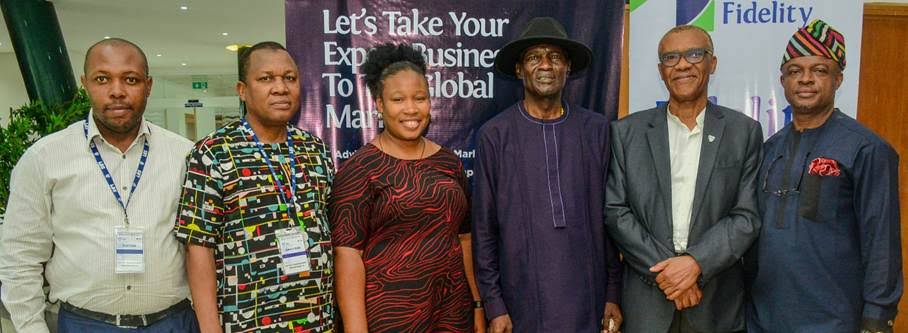
Fidelity Bank Plc has reinforced its commitment to Nigeria’s economic diversification agenda by equipping exporters with the skills and knowledge required to compete in regional and global markets.
The bank demonstrated this commitment through the 19th edition of its Export Management Programme (EMP 19), held recently at the Lagos Business School (LBS), Ajah, Lagos.
Organised in partnership with the Lagos Business School and the Nigerian Export Promotion Council, the programme brought together entrepreneurs, professionals, regulators, and aspiring exporters for intensive training on export management and international trade.
Speaking at the closing ceremony, Isaiah Ndukwe said Fidelity Bank remains focused on helping Nigerian businesses take advantage of emerging opportunities under the African Continental Free Trade Area.
According to him, capacity building remains one of the most effective tools for unlocking Nigeria’s vast export potential.
“Through the Export Management Programme, we equip businesses with practical knowledge, market intelligence, and strategic insights needed to compete successfully in regional and global markets,” Ndukwe said.
He added that AfCFTA has created new opportunities for trade across Africa. Consequently, Fidelity Bank aims to ensure Nigerian exporters are well-positioned to benefit from the continental market and contribute to the country’s economic diversification efforts.
Furthermore, Ndukwe noted that the bank will continue to provide exporters with financial solutions, advisory services, and strategic partnerships to support business expansion beyond Nigeria’s borders.
Experts Stress Need for Continuous Export Training
Meanwhile, the Director of the Export Management Programme at Lagos Business School, Frank Ojadi, highlighted the importance of continuous learning in the evolving global trade environment.
According to Ojadi, frequent policy changes, improved trade processes, and growing business interest in exports make capacity development increasingly important.
“The export market is always evolving. Therefore, businesses must continually strengthen their capabilities to remain competitive,” he said.
He explained that EMP 19 placed strong emphasis on AfCFTA and exposed participants to both the theoretical and practical aspects of trading across African markets.
As a result, participants gained valuable insights into how to identify opportunities, overcome challenges, and expand their businesses beyond domestic markets.
Negotiation Skills Critical to International Trade
Also speaking, Senior Fellow and Head of the Department of Organisational Behaviour and Human Resources Management at Lagos Business School, Uche Attoh, stressed the importance of negotiation and dispute resolution in international commerce.
Attoh noted that successful trade relationships often depend on effective negotiation, while arbitration remains essential for resolving disputes when they arise.
Once businesses understand these principles, he said, they can confidently operate in markets across Africa, Europe, and the Americas.
Participants Laud Programme’s Impact
Several participants described the programme as practical, impactful, and career-enhancing.
Among them was Obinna Oforum, who said the training strengthened his determination to become an export advocate.
Similarly, Orji Samuel commended Fidelity Bank and Lagos Business School for making the programme accessible through subsidised participation costs.
He noted that the knowledge acquired would help participants navigate export challenges, identify new markets, and create sustainable business opportunities.
Driving Nigeria’s Non-Oil Export Growth
The Export Management Programme remains Fidelity Bank’s flagship capacity-building initiative for developing export-ready businesses and professionals.
Through strategic partnerships and targeted interventions, the bank continues to support trade facilitation, strengthen export competitiveness, and promote sustainable economic growth.
As Nigeria seeks to reduce its dependence on oil revenues, initiatives such as EMP 19 are expected to play a crucial role in preparing local businesses to compete effectively within Africa and the global marketplace.
