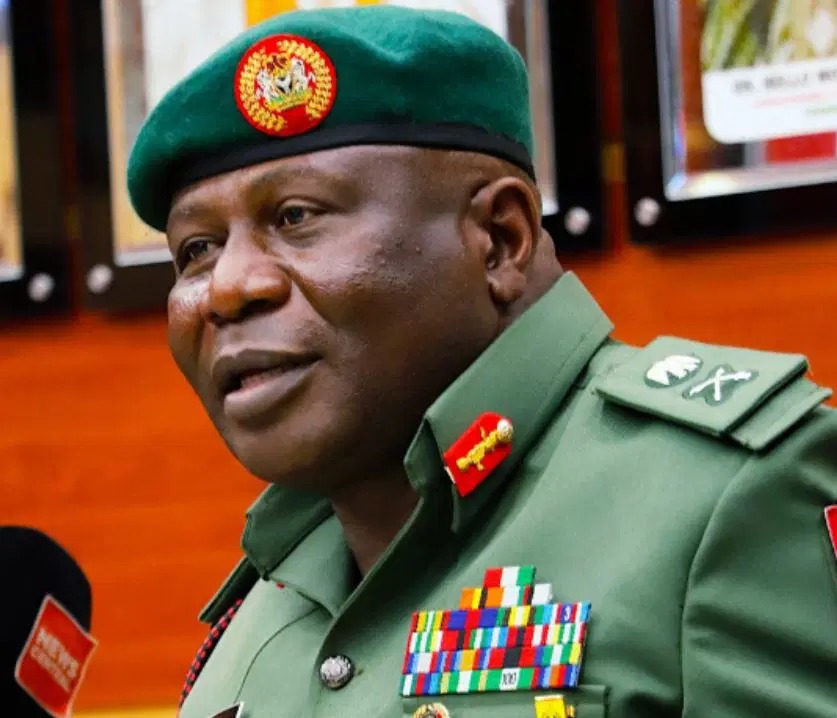
Chief of Army Staff (COAS), Lt.-Gen. Olufemi Oluyede has issued a pointed call for institutional accountability in military training, stating that the calibre of soldiers produced by the Nigerian Army Depot directly shapes both the Army’s operational credibility and the public’s trust in its mission.
During his inaugural operational visit to the Army’s training depot in Osogbo on Monday, Oluyede emphasized that military training is not merely procedural but a critical national investment in security infrastructure.
His remarks, captured in a statement by Acting Director of Army Public Relations, Lt.-Col. Appolonia Anele, challenged officers and instructors to move beyond routine drills and commit to purpose-driven, quality-focused soldier development.
“The quality of soldiers you produce here reflects directly on the Nigerian Army’s image—and by extension, the security of our nation,” Oluyede said. “Training must not only be effective but inspired by a sense of duty, discipline, and forward-looking capacity building.”
The COAS’s visit was more than ceremonial. He conducted a rigorous inspection of training facilities and infrastructure, engaging directly with instructors and assessing their methodologies. According to sources familiar with the visit, Oluyede focused on evaluating whether current training standards meet the demands of modern warfare and Nigeria’s diverse security challenges—from counterterrorism to cyber threats and asymmetric warfare.
Analysts say his emphasis on accountability signals a strategic shift. Rather than focusing solely on field operations, the Army appears to be turning attention inward—recognizing that operational weaknesses often stem from inadequate foundational training.
By inspecting the depot’s infrastructure and scrutinizing its readiness levels, Oluyede highlighted a recurring concern among security experts: that Nigeria’s military effectiveness begins, or breaks, at the training ground. With security operations stretching across multiple fronts—Boko Haram in the Northeast, banditry in the Northwest, and separatist unrest in the Southeast—the Army can ill-afford gaps in its recruitment and training pipeline.
His visit also comes amid rising public scrutiny of military performance and professionalism. For the Army to maintain legitimacy and moral authority, Oluyede argued, every new recruit must embody competence, discipline, and adaptability from day one.
He urged instructors to “train with passion,” emphasizing that quality assurance must become central to the Army’s internal processes. “This is not just about skills; it is about ethos, about building a force Nigerians can trust,” he added.
While the statement did not specify deficiencies, it strongly suggested that improvements are needed. Observers believe that Oluyede’s hands-on assessment could inform future reforms, including the modernization of training curricula, enhanced welfare for trainers, and increased investment in simulation technology and modern combat readiness tools.
As the military continues to face evolving threats, the Depot’s role as a foundational institution is back in the spotlight. The COAS’s visit signals that accountability is now being pushed upstream—where soldiering begins, not just where it is tested.
