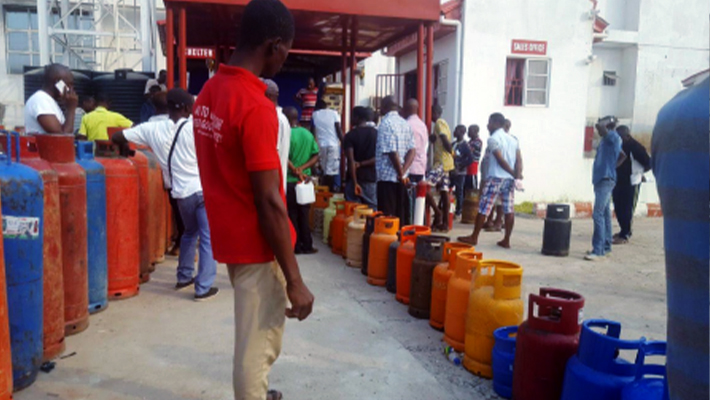
The scarcity of liquefied petroleum gas (LPG), popularly known as cooking gas, has hit major Nigerian cities, triggering sharp price increases and supply shortages across the country.
Investigations by Newshubmag.com revealed that a kilogram of cooking gas now sells between ₦1,800 and ₦3,500 in parts of Lagos and Ogun States, while other regions such as Port Harcourt, Cross River, Kano, and Kaduna are also witnessing significant price spikes.
The crisis, according to industry operators, was worsened by last week’s nationwide strike by the Petroleum and Natural Gas Senior Staff Association of Nigeria (PENGASSAN), which disrupted supply chains following protests over staff retrenchments at the Dangote Refinery.
Although the union has since suspended its strike, the temporary shutdown created a ripple effect across gas distribution networks, leading to product rationing, stock depletion, and widespread price hikes.
Price surge across cities
In Abuja, the price of refilling a 12.5kg cylinder has jumped from around ₦13,000 to between ₦17,000 and ₦18,750, depending on location. Retailers in Wuse, Garki, and Kubwa confirmed that 1kg of gas now sells for between ₦1,350 and ₦1,500, while some outlets in Jabi price the same quantity even higher.
In Lagos and Ogun States, consumers reported dramatic increases over the weekend. As of Friday, 1kg sold for ₦1,300, rising to ₦1,400 on Saturday and ₦1,600–₦1,800 on Sunday, depending on the retailer. Many gas stations had no stock as of Sunday morning, while those still operating raised their prices sharply.
Industry leaders explain shortage
The President of the Nigerian Association of Liquefied Petroleum Gas Marketers (NALPGAM), Olatunbosun Oladapo, attributed the scarcity to a temporary supply disruption caused by the PENGASSAN strike and internal maintenance activities at the Dangote Refinery.
According to him, the strike disrupted vessel berthing at Lagos terminals, creating a bottleneck in supply to the southwest region. However, NLNG’s recent large-volume deliveries to Port Harcourt have cushioned the impact in the South-South, where the scarcity is less severe.
“Normalcy should return within days as Dangote and other suppliers resume full-scale loading,” Oladapo assured.
“Most of our LPG supply is now produced locally, and importation is minimal. In fact, importing now could result in losses due to the strength of local production.”
Experts blame structural bottlenecks
Energy law expert and Bloomfield LP Partner, Dr. Ayodele Oni, noted that despite Nigeria’s increased upstream gas and natural gas liquids (NGL) production, domestic shortages persist due to export prioritization.
“Higher production doesn’t automatically mean more gas for domestic use,” Oni said.
“A significant portion of locally produced LPG is still exported rather than being allocated for local bottling and retail.”
He cited data showing that domestic gas sales rose by 22% year-on-year to about 65,632 metric tonnes as of March 2025, yet domestic availability remains constrained because producers prefer exporting for higher margins.
Outlook
While marketers and regulators expect normal supply to resume soon, consumers across Nigeria continue to feel the pinch of the current scarcity. The situation underscores the country’s ongoing struggle to balance its export-driven gas economy with domestic energy needs.
Industry observers argue that without structural reforms in distribution, pricing, and domestic allocation, Nigeria’s periodic cooking gas crises may persist — despite being one of Africa’s top natural gas producers.
LPG scarcity: Nigerians groan as cooking gas price soars to ₦3,500 per kg
101
