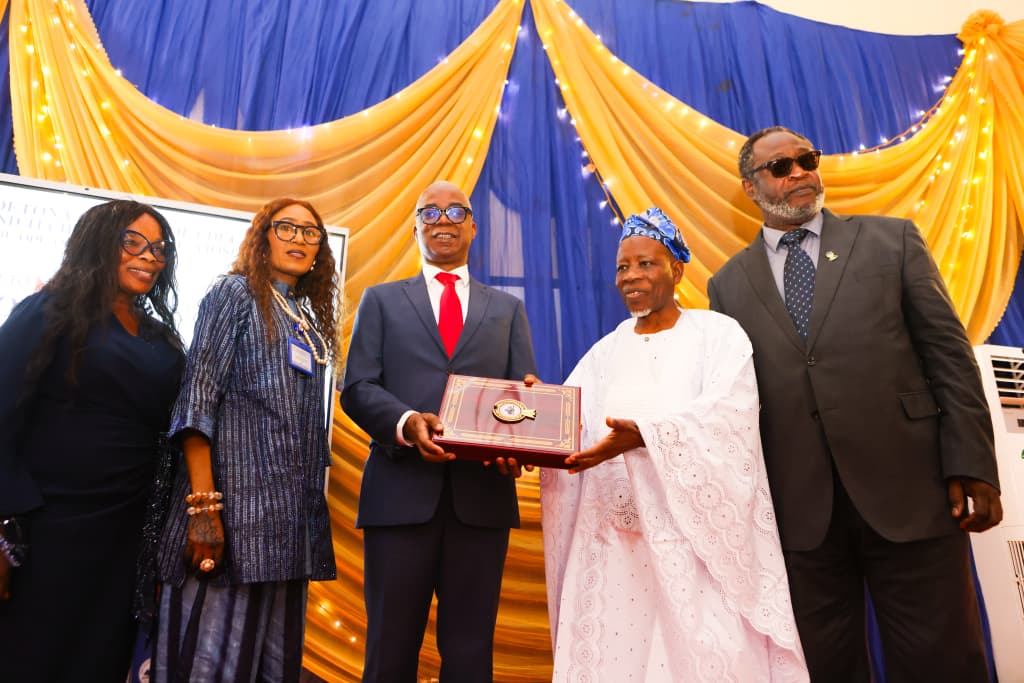
Dr Tunji Olowolafe, Chancellor of Ekiti State University (EKSU), has emphasised the central role of teachers in producing responsible leaders and building a nation founded on knowledge, character and enduring values, declaring that the future of Nigeria’s leadership begins in the classroom.
Olowolafe made this submission while delivering the 2026 Convocation Lecture at the Sikiru Adetona College of Education, Science and Technology (SACOETEC), Omu-Ajose, Ogun State, where he described teachers as the architects of the minds, values and abilities that ultimately shape the direction of society.
Speaking on the theme, “The Dual-Mandate NCE-Degree Programme: Prospects, Challenges and the Future of Teacher Education in Nigeria,” he argued that the importance of teachers extends far beyond the delivery of academic lessons, as they lay the foundation upon which future leaders, professionals, entrepreneurs and nation-builders emerge.
He noted that some of Nigeria’s most prominent leaders, including the country’s first Prime Minister, Sir Abubakar Tafawa Balewa, former President Shehu Shagari and Chief Obafemi Awolowo, had backgrounds in teaching, demonstrating the profession’s historic contribution to leadership and national development.
According to him, teaching is not merely a career but a nation-building responsibility, requiring individuals who can combine intellectual competence with discipline, integrity, empathy and a commitment to the development of others.
He stressed that leadership is not built overnight or acquired simply through political positions, academic qualifications or professional achievements. Rather, its foundations are laid early through the values, knowledge and habits instilled in individuals by teachers and other educators.
Olowolafe consequently commended President Bola Ahmed Tinubu and the Minister of Education for advancing the Dual-Mandate NCE-Degree Programme, describing it as a significant reform that would strengthen teacher education, restore the dignity of Colleges of Education and produce better-equipped educators.
Under the programme, students can obtain an NCE after three years and proceed to earn a Bachelor’s degree within the same institution after another two years. He said the arrangement would combine practical teaching competence with academic depth, strengthening the capacity of graduates to nurture future generations.
He also highlighted the importance of TETFund and NELFUND in sustaining educational development, citing the fact that approximately 80 per cent of SACOETEC’s buildings were funded through TETFund interventions as evidence of the impact of sustained investment in education.
Beyond infrastructure and access to education, the Chancellor described a virtuous circle in which excellent teachers produce knowledgeable, skilled and innovative citizens, who contribute to business productivity and economic growth, thereby creating more resources for investment in education.
He maintained that no nation could achieve sustainable economic transformation without first investing in the people responsible for shaping its human capital.
To encourage this culture of excellence, Olowolafe announced annual incentives through the Tunji Olowolafe Foundation for outstanding students and lecturers at SACOETEC, reinforcing the importance of rewarding hard work, academic distinction and effective teaching.
He also announced plans to establish a solar-powered GOMTECH ICT centre at the College, equipped with Starlink connectivity to promote digital education, artificial intelligence and technology-driven learning.
While urging teachers to embrace emerging technologies, he cautioned that artificial intelligence could not replace the human qualities essential to education, particularly empathy, moral instruction, patience and the ability to inspire young people.
He challenged the graduating students to understand that their influence would extend beyond the classroom, as the minds they nurture today could become the leaders who determine Nigeria’s future.
For Olowolafe, the quality of a nation’s leadership is inseparable from the quality of its teachers. He therefore urged the country to accord the teaching profession the recognition, investment and support it deserves, stressing that building responsible leaders and a prosperous society must begin with getting education and teacher development right.
