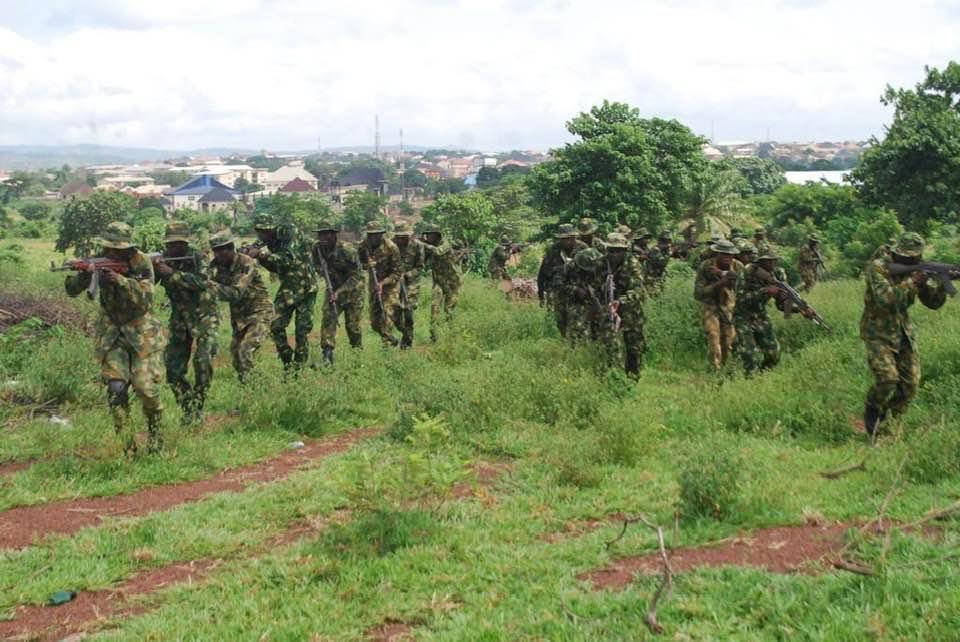
As the Nigerian Army intensifies counterterrorism and internal security operations nationwide, its recent crackdown across multiple states underscores the fragmented nature of Nigeria’s security crisis—one shaped by region-specific threats, local criminal networks, and divergent community responses.
In the past week alone, military operations resulted in the arrest of 199 suspects and the disruption of criminal activities in no fewer than eight states and the Federal Capital Territory (FCT). From combating insurgency in the Northeast to tackling cybercrime in the South-South and quelling rural banditry in the Northwest, the sweep offers a revealing snapshot of Nigeria’s complex and decentralized security landscape.
In Borno State, the heartland of Nigeria’s 14-year-old insurgency, troops of the 202 Battalion ambushed and neutralized a suspected logistics courier for the ISWAP/JAS faction near Bama. Working in tandem with the Civilian Joint Task Force (CJTF), the Army recovered a bicycle and mechanical parts believed to be vital to terrorist supply chains. This operation underscores how insurgency in the Northeast remains deeply embedded in local logistics and informal networks.
In the Northwest, states like Sokoto and Katsina presented a different challenge—banditry and rural criminality. Troops from the 8 Division Garrison Strike Team intercepted a drug trafficking ring in Sokoto, while in Katsina, soldiers repelled an ambush on police forces, apprehending notorious terrorist leader Muhammadu Hamisu (aka Mamiyo). The Northwest continues to grapple with mobile armed groups that blur the lines between terrorism and organized crime.
In Kogi, the army’s arrest of a kidnap suspect linked to an insurgent leader reveals a growing cross-regional threat corridor stretching from central Nigeria into the Southwest. Similar dynamics were observed in Edo State, where troops raided hideouts in EMU Forest, recovering firearms, motorcycles, and over ₦500,000 in cash—hinting at an entrenched network of rural banditry extending into forested southern zones.
The Federal Capital Territory was not spared. Along the Lokoja-Abaji corridor, the 176 Guards Battalion and ONSA Quick Response Teams intercepted three extremist informants. Their presence so close to Abuja’s core has renewed concerns about the encroachment of insurgency and the vulnerability of key federal assets.
Perhaps the most surprising development came from Delta State, where troops uncovered a cybercrime training center in Warri. Over 180 suspected internet fraudsters were arrested and 274 laptops and other scam-enabling tools seized. This marks a clear pivot in Nigeria’s internal security operations—from kinetic combat to tech-focused criminal disruption in the South-South.
In Plateau, under Operation Safe Haven, troops apprehended a notorious cattle rustler and a suspect tied to recent killings in Mangu Local Government Area—again drawing attention to persistent ethno-religious tensions and resource conflicts in the Middle Belt.
A senior military source who briefed reporters stated: “These operations send a clear message to enemies of the state—there is no safe haven for those who threaten Nigeria’s peace.” Yet experts argue that the disparate nature of these operations reveals not just tactical agility, but the lack of a unified national security architecture capable of addressing local root causes.
Community vigilante collaboration, presence of hybrid forces from the Office of the National Security Adviser (ONSA), and joint task teams have proven effective in some zones—but their uneven implementation and dependency on state-level coordination raise questions about sustainability.
While the Nigerian Army’s kinetic success is commendable, the broader question remains: Can national-level interventions adapt swiftly enough to Nigeria’s highly localized and evolving threat profiles?
Until systemic solutions are aligned with regional contexts—from Borno’s terror corridors to Delta’s cybercrime syndicates—the security forces may win battles but risk losing sight of the broader war for lasting peace.
